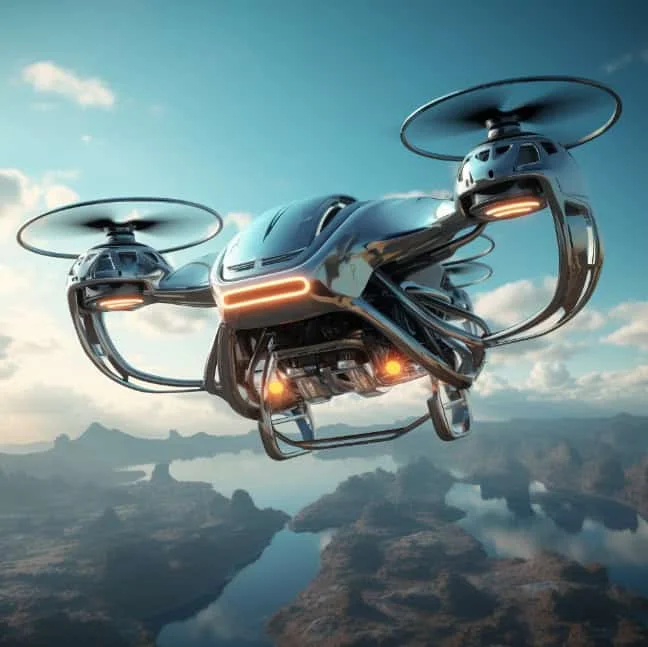
Drifting Into the Future: Drone Development - Is It Really a Game Changer?
Drones have evolved from hobby gadgets into a multi-industry platform - thanks to advances in communications, sensors, materials, and AI.
In Brief
The development and production of stable, lightweight drones has advanced dramatically in recent years thanks to fast, multi-disciplinary technology progress. Looking at the main drivers behind that progress gives a useful frame for understanding the innovation behind drones - and why drones are a real game changer rather than a passing trend.
Wireless Communications
Major progress in wireless communications has dramatically improved drones' ability to control themselves in real time. Improvements in network technology and remote-control links - signals and control, near and far communications, wireless internet - allow operators to receive real-time data and use it to program drone actions stably and efficiently.
Smart Sensors and Computer Vision
Advanced sensors and smart technologies - GPS tracking, energy-efficiency sensors, computer vision, image-analysis systems - have given drones the ability to identify and track their environment precisely. These capabilities let them navigate autonomously and focus on specific missions accurately and efficiently.
Lightweight, Strong Materials
Development of new materials - advanced plastics, fiberglass, strong ceramics - has enabled lightweight, efficient drone parts. The new materials handle high stresses, are durable in water and weather, and provide better support for onboard systems.
AI and Autonomy
AI brings autonomy: path planning, obstacle avoidance, mission learning, swarm coordination. Drones move from remote-controlled toys to autonomous platforms - the difference between a remote-control plane and a self-driving aircraft.

Tip From the Experts
When developing a drone-based product, the hardest engineering problem is usually not the airframe - it's the integration of communications, sensors, and software with regulatory compliance. Plan for certification early and design the airframe around the certified subsystems, not the other way around.
Industry Applications
Drones now serve agriculture (crop monitoring, precision spraying), construction (site surveys, progress tracking), security and search-and-rescue, infrastructure inspection, last-mile delivery, and entertainment. Each industry has unique requirements - and each is a candidate for tailored drone product development.
Key Takeaways
Wireless Communications
Real-time control across distance and obstacles.
Smart Sensors
GPS, computer vision, image analysis, autonomy.
Lightweight Materials
Plastics, fiberglass, ceramics - light and strong.
AI-Driven Autonomy
From remote-controlled toy to autonomous platform.
Industry Applications
Agriculture, construction, security, delivery, more.
Compliance Is the Hard Part
Plan certification before airframe finalization.
Frequently Asked Questions
Is drone development still worth it?
Yes - especially for vertical applications where a tailored drone outperforms general-purpose platforms.
Can ATI develop a custom drone?
Yes. We've developed drones and drone subsystems, focusing on reliable mechanical and electronic integration.
How long does drone development take?
12-24 months for a fully certified custom drone, depending on complexity.
What are the biggest engineering challenges?
Battery life, communications reliability, sensor integration, and certification.
Are drones regulated in Israel?
Yes. Civil Aviation Authority rules govern weight classes, registration, and operating zones. ATI helps plan around them.
Can I manufacture a drone in China?
Often yes - but the IP and supplier vetting need extra care for sensitive subsystems. Sometimes split sourcing is preferable.