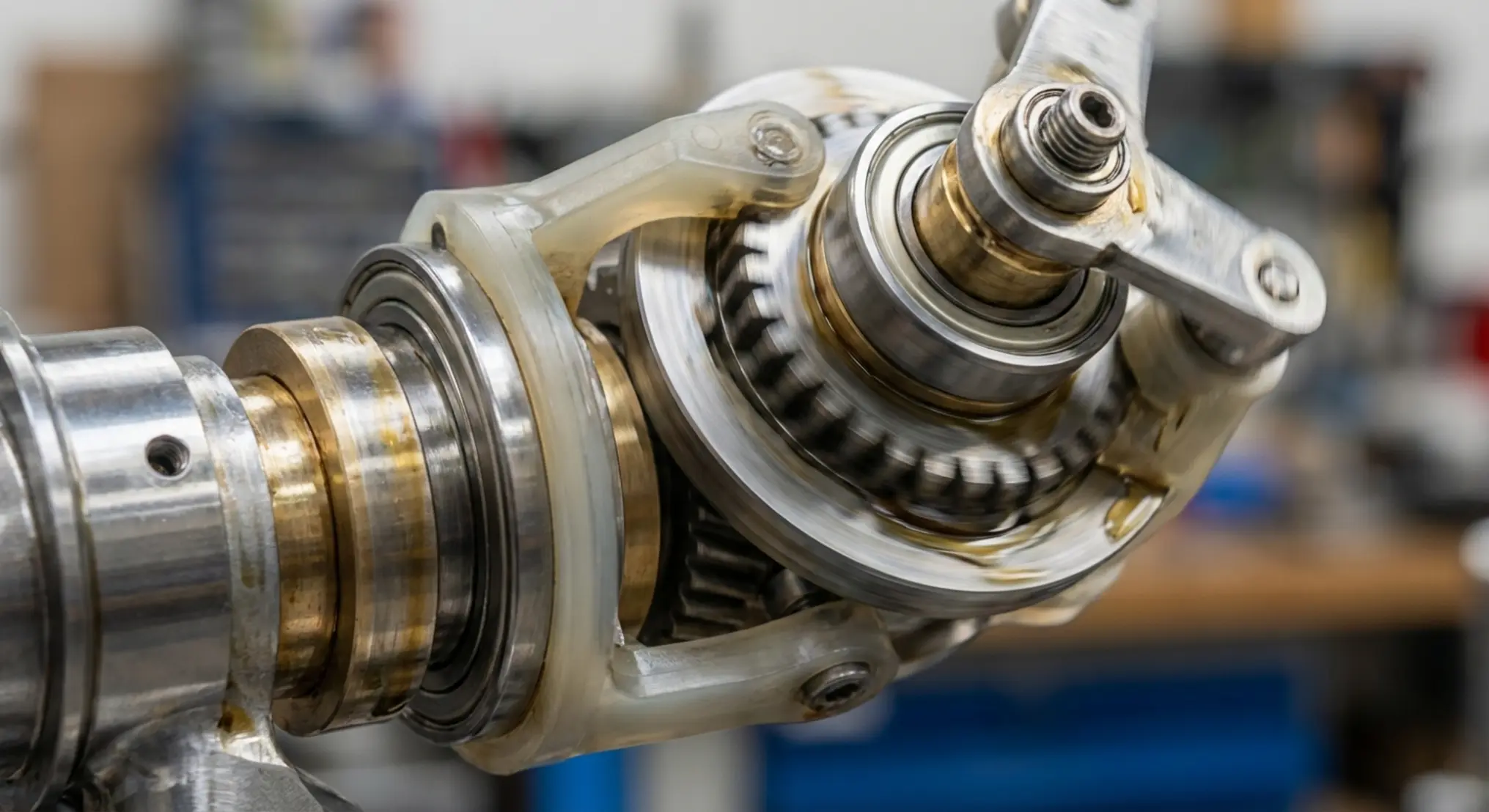
Hinge & Mechanism Engineering: How to Prevent Long-Term Wear
Preventing wear in hinges and moving mechanisms requires a precise combination of smart engineering design and correct material selection.
In Brief
Preventing wear in hinges and moving mechanisms requires a precise combination of smart engineering design and correct material selection. The primary cause of failure in these mechanisms is continuous friction that generates heat and mechanical wear on surfaces. To prevent this, it is common to use materials with self-lubricating properties such as Polyacetal (POM) alongside materials with high impact resistance like Nylon, while ensuring that different materials are paired at contact points to prevent molecular adhesion and mutual wear.
Beyond material selection, the key to longevity of any moving mechanism lies in conducting comprehensive lifecycle tests during the development stage. These tests, typically performed using dedicated robotic test rigs, simulate years of daily use and reveal the hidden weak points of the design. Only through repetition, precise measurement, and continuous improvement of the prototype can you arrive at a reliable, high-quality final product that will stand the test of time.
When we talk about developing technological or mechanical products, one of the most significant vulnerabilities hides in the smallest details - in those hinges and moving mechanisms that must operate smoothly thousands, and sometimes tens of thousands, of times. As someone who has accompanied entrepreneurs from the idea stage through to mass production, I've seen time and again how a brilliant product concept fails the test of reality simply because its delicate mechanics weren't properly designed to withstand wear.
A winning product isn't just about impressive exterior design or advanced electronics - it's about a deep understanding of materials engineering, load distribution, and the dynamics of motion. In this article, we'll explore the world of precision mechanics and explain how smart material selection and careful design can ensure your product works perfectly even after years of intensive use.
Fundamentals of Precision Mechanics in Moving Mechanisms
The world of precision mechanics demands detailed attention to every single component in a product. When designing a hinge, gear, or any mechanism with moving parts, we face complex physical phenomena. The science that studies friction, wear, and lubrication between surfaces in relative motion is called Tribology. A basic understanding of tribological principles is essential for every engineer and product designer.
The central challenge in moving mechanisms is managing the energy generated during motion. Every time two surfaces slide against each other, friction is created. This friction translates into heat energy and shear forces acting on the material surface. Without careful design, these forces will tear microscopic particles from the surface - a process we simply know as wear. As wear progresses, the gaps between parts increase, movement becomes loose, unwanted noises develop, and eventually the mechanism collapses entirely.
Factors That Accelerate Wear in Mechanical Systems
There are several key factors that affect the wear rate of a given mechanism. The first is the load applied to the contact point - the higher the point pressure, the greater the friction. Proper design will aim to distribute the load over the widest possible surface area. The second factor is the speed of movement. Excessive speed doesn't allow heat to dissipate into the surroundings, which can lead to localized melting of plastic components.
The third and most critical factor is surface roughness. Even a surface that appears smooth to the naked eye looks like a mountain range of hills and valleys under a microscope. When two such surfaces come into contact, the microscopic peaks collide and break. Therefore, the mold finish quality in the manufacturing process directly impacts the product's lifespan.
Choosing the Right Materials to Prevent Friction
One of the most important decisions in the product design and development process is selecting raw materials. In the past, moving mechanisms required the use of metals and external lubricants like oil or grease. Today, thanks to advances in the polymer industry, we can use advanced engineering plastics that offer self-lubricating properties.
When evaluating polymers for moving mechanisms, the two leading and most commonly used materials in the industry are Polyacetal (also known by its abbreviation POM) and Nylon (chemically known as Polyamide). Each of these materials has unique properties that make it suitable for specific applications.
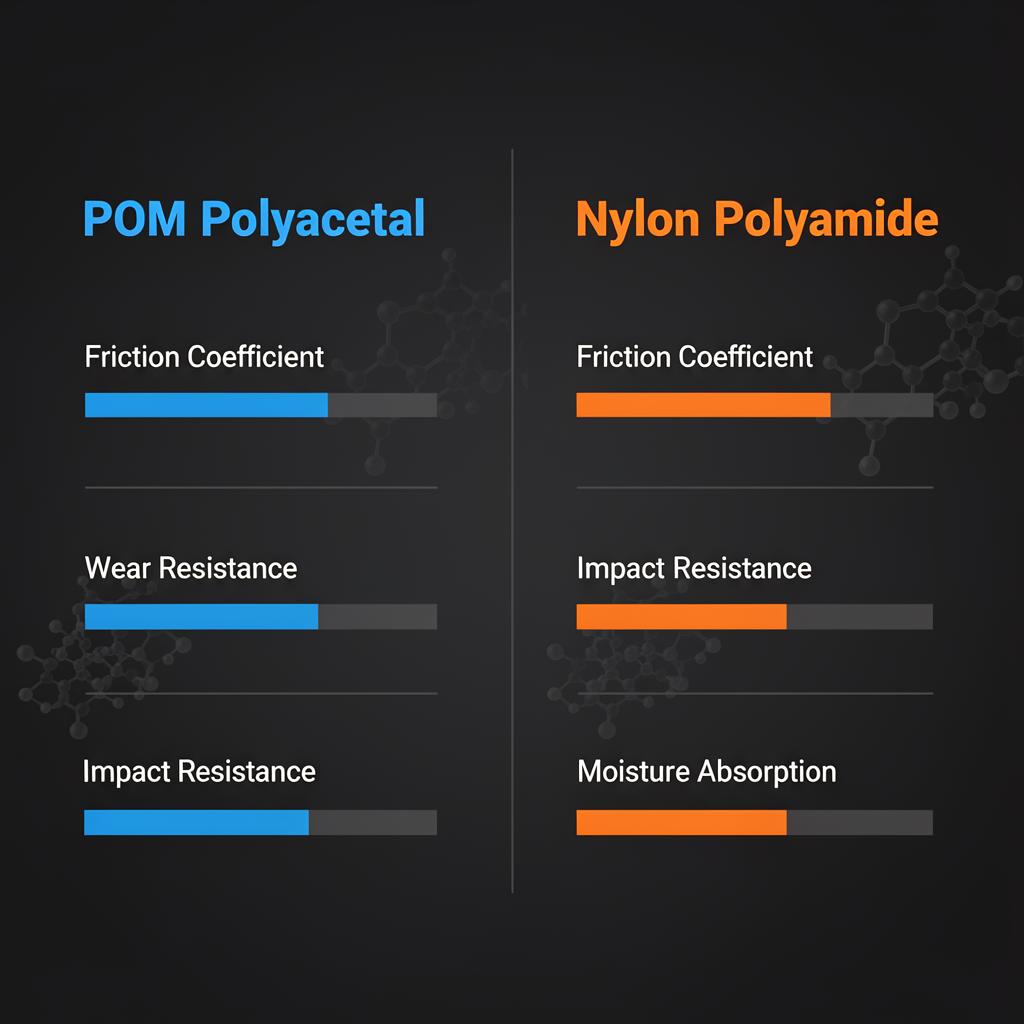
POM (Polyacetal) vs. Nylon (Polyamide)
Polyacetal is a semi-crystalline polymer that excels in high mechanical strength, excellent rigidity, and an extremely low friction coefficient. Its smooth finish and self-lubricating property make it the ideal choice for gears, ball-less bearings, and hinges requiring smooth, continuous movement. Another significant advantage of POM is its resistance to moisture absorption - its dimensions remain stable even in humid environments, which is critical for maintaining precise manufacturing tolerances.
In contrast, Nylon is a material with exceptional impact and shock resistance. It is very tough and can absorb impacts significantly better than POM. However, Nylon has a natural tendency to absorb moisture from the air. This moisture absorption changes its molecular structure, making it more flexible while simultaneously causing the material to swell and its physical dimensions to change. When designing precision hinges from Nylon, the engineer must account for expected dimensional changes resulting from humidity variations in the operating environment.
| Property | POM (Polyacetal) | Nylon (Polyamide) |
|---|---|---|
| Friction Coefficient | Very low (self-lubricating) | Medium |
| Continuous Wear Resistance | Excellent | Good |
| Impact Resistance (Shock) | Medium | Excellent |
| Moisture Absorption | Near zero (high dimensional stability) | High (may change dimensions) |
| Common Applications | Gears, hinges, slide rails | Load-bearing wheels, impact-absorbing parts |
The Iron Rule of Hinge Engineering: Combining Different Materials
A very common mistake among entrepreneurs and designers starting out is designing a hinge where both moving parts are manufactured from the exact same plastic material. From a tribological standpoint, when two surfaces of the same polymer rub against each other, their identical molecular structure causes them to tend to adhere to one another under pressure and heat. This phenomenon dramatically accelerates the wear rate and causes squeaking and disturbing noises in the mechanism.
To prevent this, at ATI we always recommend combining materials with different molecular compositions. For example, if one part of the hinge is made of POM, the opposing part that rotates inside it should be made of Nylon, Polycarbonate, or even a combination of brass metal against the plastic. The chemical difference between the materials prevents the molecular adhesion phenomenon and allows smooth, wear-free movement for years.
Engineering Design and Load Distribution
Choosing the perfect material won't help if the mechanical design is flawed. When we approach the engineering design stage, the first goal is to ensure that forces acting on the mechanism are distributed as optimally as possible. A pin that's too thin will bend under load and create excessive friction at its endpoints. A pin that's too thick may require too much material and be prone to manufacturing defects such as sink marks during plastic cooling in the mold.
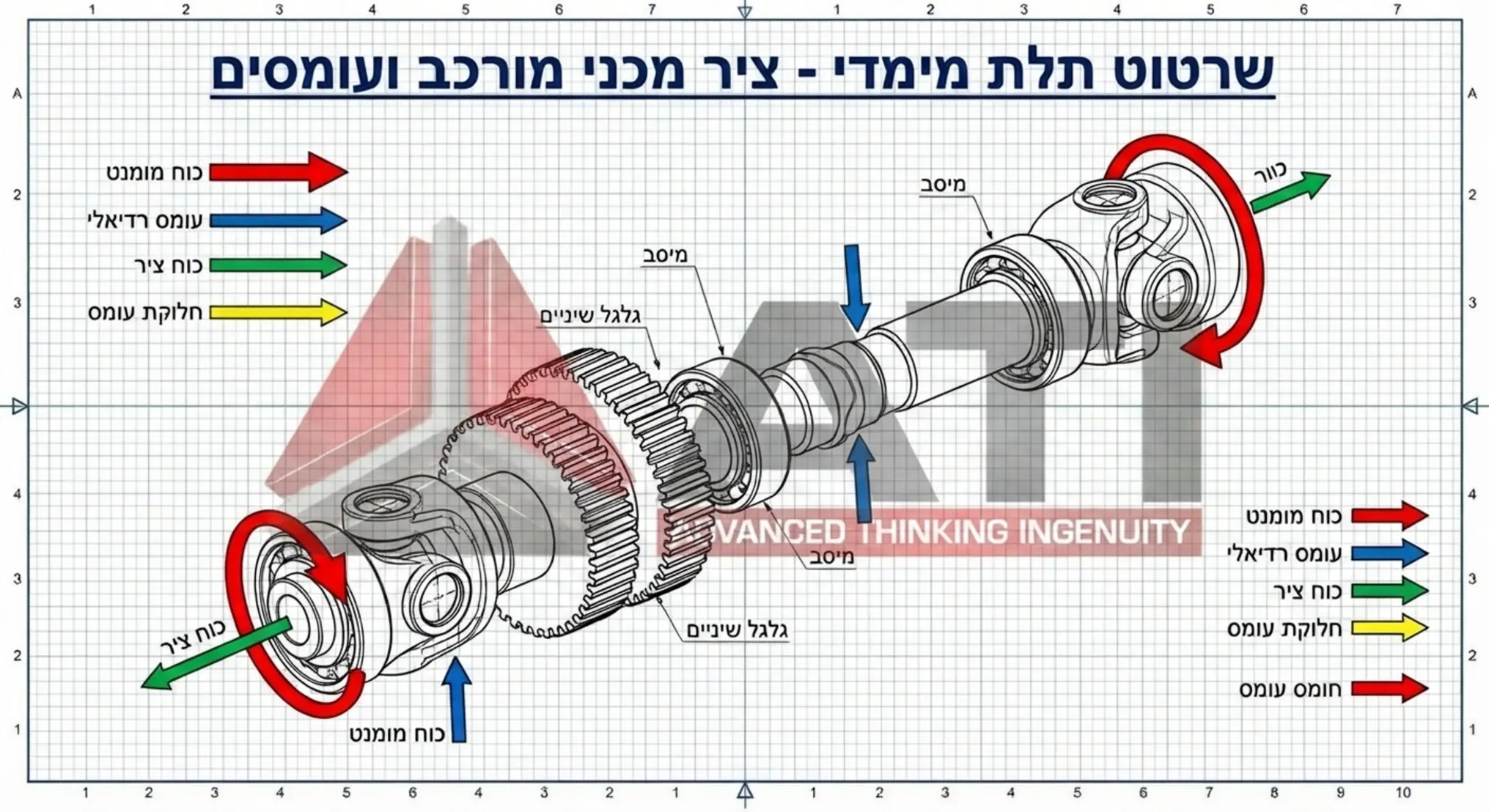
Movement Tolerances and Particle Clearance
Another component in the design is defining precise tolerances between parts. If the gap between the pin and bore is too small, the mechanism will jam. If it's too large, there will be excessive play causing vibrations and increased wear. A skilled engineer knows how to design the exact gap while accounting for material shrinkage after injection. Additionally, in complex mechanism designs, it is common to incorporate tiny channels or recesses whose function is to capture dust particles or microscopic plastic chips that shed during natural wear, preventing them from accumulating on the friction surface and acting like sandpaper that worsens the problem.
Lifecycle Testing
The key stage for ensuring mechanism quality is performing rigorous lifecycle tests. These tests are conducted according to international protocols from standards institutes such as ASTM, and their purpose is to simulate years of product use within a short period of days or weeks. The process begins with developing a functional prototype produced using exactly the same manufacturing methods and materials planned for mass production.
Environmental and Mechanical Simulation
The prototype is connected to a dedicated robotic test rig that opens and closes the mechanism or rotates the hinge tens of thousands of times continuously. During testing, sensors measure the force required to operate the mechanism, detecting abnormal increases that indicate the onset of wear. Simultaneously with the mechanical testing, the prototype is placed in climate chambers simulating extreme conditions of severe cold, high heat, and extreme humidity. The combination of tests allows us to understand exactly when and how the mechanism will fail, and to correct the engineering design accordingly before the enormous investment in mass production tooling.
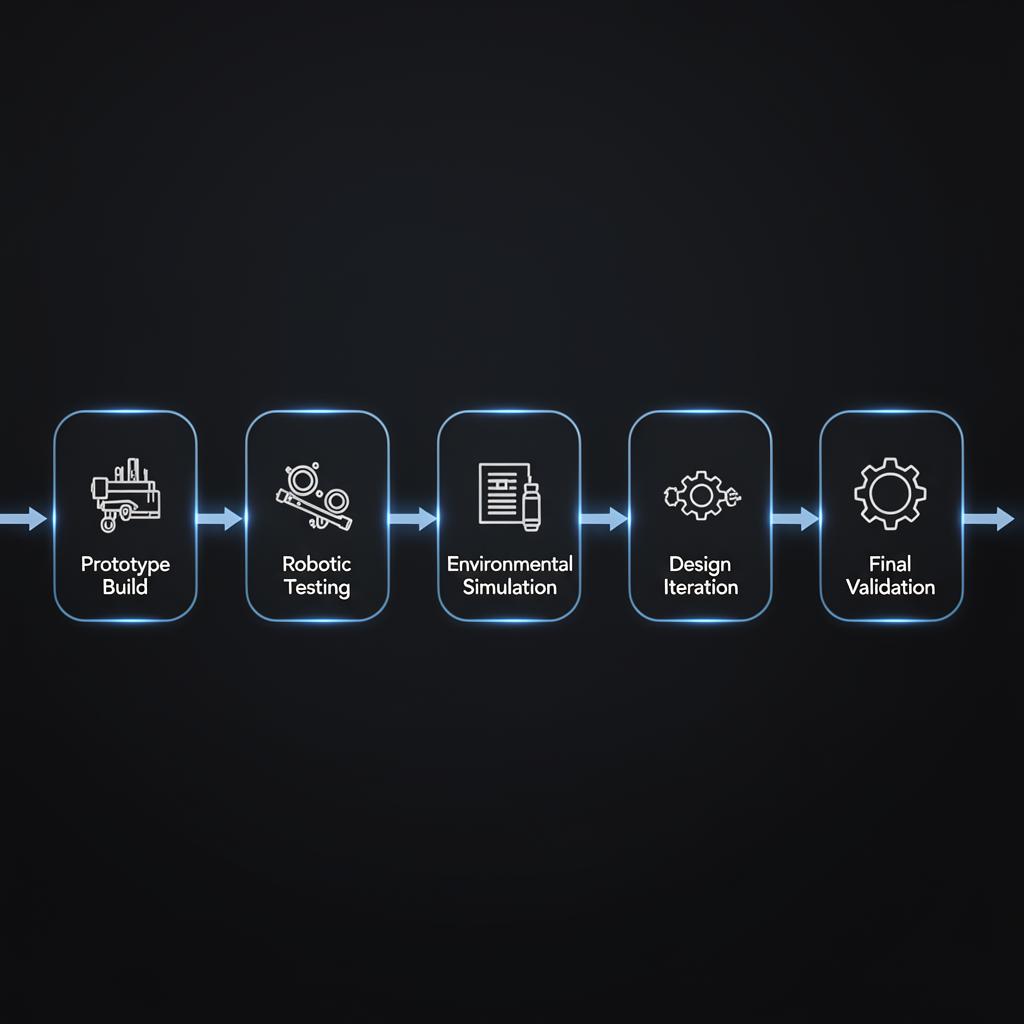
The Professional Approach to Bringing an Idea to a Finished Product
As can be understood, engineering products that include delicate mechanics is a complex process requiring multidisciplinary knowledge. It's not just about a nice drawing on a computer - it's about chemical understanding of polymer behavior, physical understanding of forces and friction, and practical understanding of manufacturing limitations. That's why when entrepreneurs approach a product development company, the expectation is to receive a complete professional envelope that examines all of these aspects.
The right way to approach projects of this type always starts with a preliminary feasibility study. Instead of diving straight into detailed design and production, we first examine the central mechanism. We determine which materials are available from the intended manufacturer, what their costs are, and whether the complex component can be produced without exceeding the project budget. This approach saves entrepreneurs enormous resources and prevents unfortunate situations where they discover that the designed product simply cannot be serially manufactured, or that it tends to wear out and break after just a few months of end-customer use.
Summary and Looking Ahead
The world of materials and mechanics is advancing by leaps and bounds. Today we're seeing polymers containing built-in nanometric lubrication additives, such as Teflon (PTFE) particles injected directly into POM, technologies enabling 3D printing of composite materials, and other novel solutions. However, the laws of physics remain unchanged. Every moving mechanism will experience friction, and our mission as engineers and product developers is to minimize it as much as possible through smart design, science-based material selection, and uncompromising quality testing.

Tip From the Experts
When approaching the design of a moving mechanism, the most common mistake is to rush into producing expensive molds. My recommendation is always to start with in-depth feasibility research and manufacture key parts as prototypes from actual industrial materials. Don't rely solely on computer simulations - there's no substitute for physical lifecycle testing in a lab that exposes the real friction and wear the product will experience in the customer's hands.
Key Takeaways
Tribology Fundamentals
Understanding friction, wear, and lubrication between surfaces in relative motion is essential for every mechanism designer.
Material Pairing
Never use the same plastic on both sides of a hinge - combine different materials to prevent molecular adhesion.
POM vs Nylon
POM excels in self-lubrication and dimensional stability; Nylon excels in impact absorption but absorbs moisture.
Tolerance Design
Precise gap sizing between pin and bore, accounting for shrinkage, determines mechanism longevity.
Lifecycle Testing
Robotic test rigs simulate years of use in days, revealing hidden weaknesses before mass production.
Feasibility First
Always start with feasibility research and real-material prototypes before investing in production tooling.
Frequently Asked Questions
What is the main cause of rapid wear in plastic hinges?
The primary cause is continuous friction under high load, especially when both moving parts are manufactured from the exact same type of plastic. This molecular identity causes the materials to adhere under the heat generated from friction, tearing microscopic particles from the surface and rapidly destroying the mechanism.
When should you choose Nylon vs. POM (Polyacetal)?
POM is ideal for mechanisms requiring smooth, continuous movement thanks to its self-lubricating property and high dimensional stability. Nylon is recommended when the mechanism is expected to absorb strong impacts or sudden shocks, but you must account for the fact that it tends to absorb moisture and its dimensions may change slightly.
Is lifecycle testing mandatory for every product?
While not every product requires it, for products containing critical moving mechanisms that could disable the product in case of failure, it is an essential step. These tests simulate years of use within a few weeks and prevent distribution of a defective product to the market, which could destroy the company's reputation and lead to costly product recalls.
How can you prevent squeaking noises from a mechanical mechanism?
Squeaking noises are usually an indication of direct friction and wear. They can be prevented by designing more precise tolerances, using a combination of different materials (such as Polycarbonate against Nylon), or using raw materials that include natural lubrication additives such as a certain percentage of Teflon (PTFE) injected directly into the plastic.
Why is feasibility research important before developing a complex mechanical hinge?
Feasibility research is designed to verify whether the mechanical concept can be manufactured at a realistic cost using available technologies. This early investigation identifies bottlenecks in the process, saves investment in fruitless engineering design, and ensures the entrepreneur understands the manufacturing costs of critical components before the project even begins.
Can 3D printing be used to test hinge wear?
In the past, 3D printing materials weren't strong enough to simulate serial production. Today, advanced technologies allow printing prototypes from rigid engineering materials and even materials equivalent to POM. This enables reasonably accurate preliminary wear testing during the development stage, although the final test must always be performed on an injection-molded part.