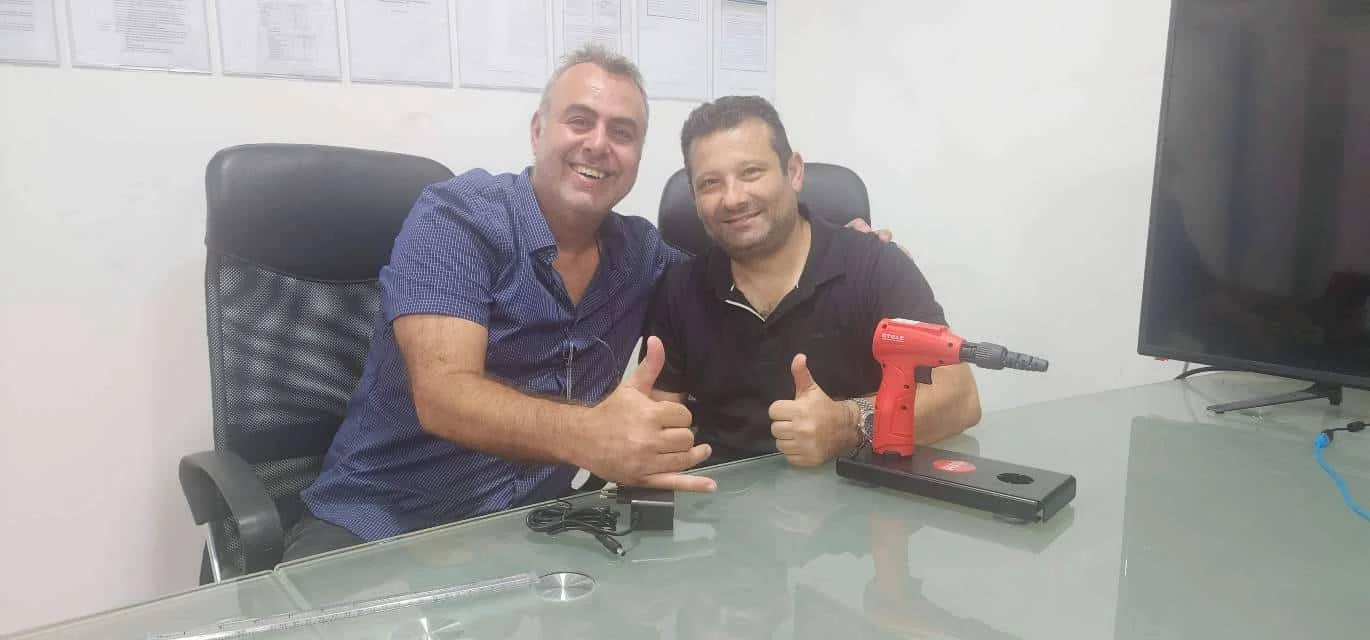
Developing a Portable Soldering Iron for Etgar Madaim
A custom safe, portable soldering iron that lets young students experience real electronics work in the classroom.
In Brief
Etgar Madaim is an Israeli company dedicated to expanding science and technology education for children and youth, combining original, creative thinking with innovative classroom programs and smart-board teaching.
Etgar Madaim approached us with a clear brief: develop a portable, classroom-safe soldering iron that allows children and youth to experience real electronics work, including patenting a novel mechanism that supports independent operation.
The Challenge
Soldering irons are by nature a hazard. Bringing one into a classroom of young learners requires a complete rethink of the form factor: lower temperatures, safer handling, no exposed live elements, fast cool-down, and a stand that prevents accidental burns.
On top of safety, the iron had to be inexpensive enough to deploy at scale across classrooms and easy enough that an instructor could oversee a full group simultaneously.
Our Approach
We started with deep field research - sitting in actual Etgar Madaim sessions, watching how instructors taught soldering safety, and identifying every moment where a child's natural movement created risk.
From there, we converged on a portable form factor with an integrated heat shield, an automatic shutoff, and a cradle-and-stand system that physically prevents the most common accidents. The heating mechanism was designed to deliver workable soldering performance at controlled, lower peak temperatures.
Engineering and Patent Development
We developed the unique heating and shutoff mechanism in parallel with a patent strategy, protecting the novel elements that distinguish this iron from anything available off the shelf.
Mechanical, electronic, and ergonomic engineering were performed together to ensure the final product was safe, reliable, and inexpensive to produce.
Prototyping and Field Testing
We iterated multiple prototypes, testing each in actual classrooms with the real instructors and students. Each round surfaced details - weight balance, cable routing, on/off feedback - that no lab test would have caught.
The final version landed on a design that instructors could supervise comfortably and that students could use confidently from the first session.
From Prototype to Production
We translated the validated prototype into a manufacturable design, selected suppliers, and supported initial production runs - keeping the unit economics tight enough for Etgar Madaim to deploy widely across their educational programs.
The result is a product that does something most soldering irons can't: live safely in the hands of young learners while still being a real working tool.

Tip From the Experts
When you're designing a tool for an environment outside your own, spend more time observing than designing. We learned more from one afternoon in a real classroom than from two weeks of internal review meetings - and that informed practically every detail of the final product.
Key Takeaways
Designed for Safety
Heat shield, auto-shutoff, and protective cradle prevent burns.
Built With Real Users
Tested in real classroom sessions, not just our lab.
Patent Protection
Novel heating and shutoff mechanism filed for patent.
Production Ready
Designed for cost-effective, repeatable manufacturing.
Education-First
Lets students experience real electronics work confidently.
Scalable Deployment
Affordable enough to roll out across full programs.
Frequently Asked Questions
Why develop a custom iron rather than buy a commercial one?
No off-the-shelf iron met the safety, supervision, and price needs of an active classroom program. A custom design solved all three at once.
Is this just a low-power iron?
No - it's a redesigned tool with a custom thermal profile, integrated guards, and shutoff logic. Lower peak temperature is one element among several, not the whole solution.
How young can students use it?
Etgar Madaim's program defines the appropriate age. The product is designed to be safely operable by school-age children under proper instructor supervision.
What was the role of patent protection?
The novel heating and shutoff mechanism was filed as a patent to protect Etgar Madaim's investment and prevent direct copies from undercutting their educational program.
How long did the project take?
From first brief to production-ready design, the project ran through several months of research, prototyping, classroom testing, and engineering, with each round informing the next.
Can ATI build similar custom tools for other educational programs?
Yes. We routinely design hardware for education, training, and other specialized contexts where general-purpose tools don't fit the user or the environment.