
When to File a Patent Application: Timing Is Everything
Why rushing to file a patent before completing development can backfire - and how to get the timing right.
In Brief
The short answer is that you should wait with filing legal documents until after completing the main development stages and creating a proof of concept or a working prototype. The reason is that at the beginning of the process, the invention is not yet fully formed from an engineering perspective, and many technical solutions that will be implemented in the final product have not yet been tested or proven in the field.
Filing too early can lock you into a specific technological solution that may later prove unfeasible. In such cases, any necessary engineering change not mentioned in the original documents will remain without legal protection, requiring new filings, significant expenses, and potentially leaving gaps for competitors to copy your updated solutions.
Many entrepreneurs come to us with a spark in their eyes and revolutionary ideas, proudly telling us they have already filed a provisional or full application with the authorities. That pride is often replaced by a big question mark when we explain that they may have made a mistake. Having accompanied hundreds of development processes, I see how rushing too quickly to register rights can tie the inventor's hands and jeopardize the entire venture. Making the right decisions in the early stages is critical to your project's success and to saving significant costs.
Many entrepreneurs who come to us arrive with unrefined ideas and have already filed a provisional patent application, or a full patent application. The pride that fills them when they pull out the documents sometimes turns into a puzzled expression when we explain that filing a patent application before you finish developing the product is sometimes a mistake.
So When Should You a Patent Application? File
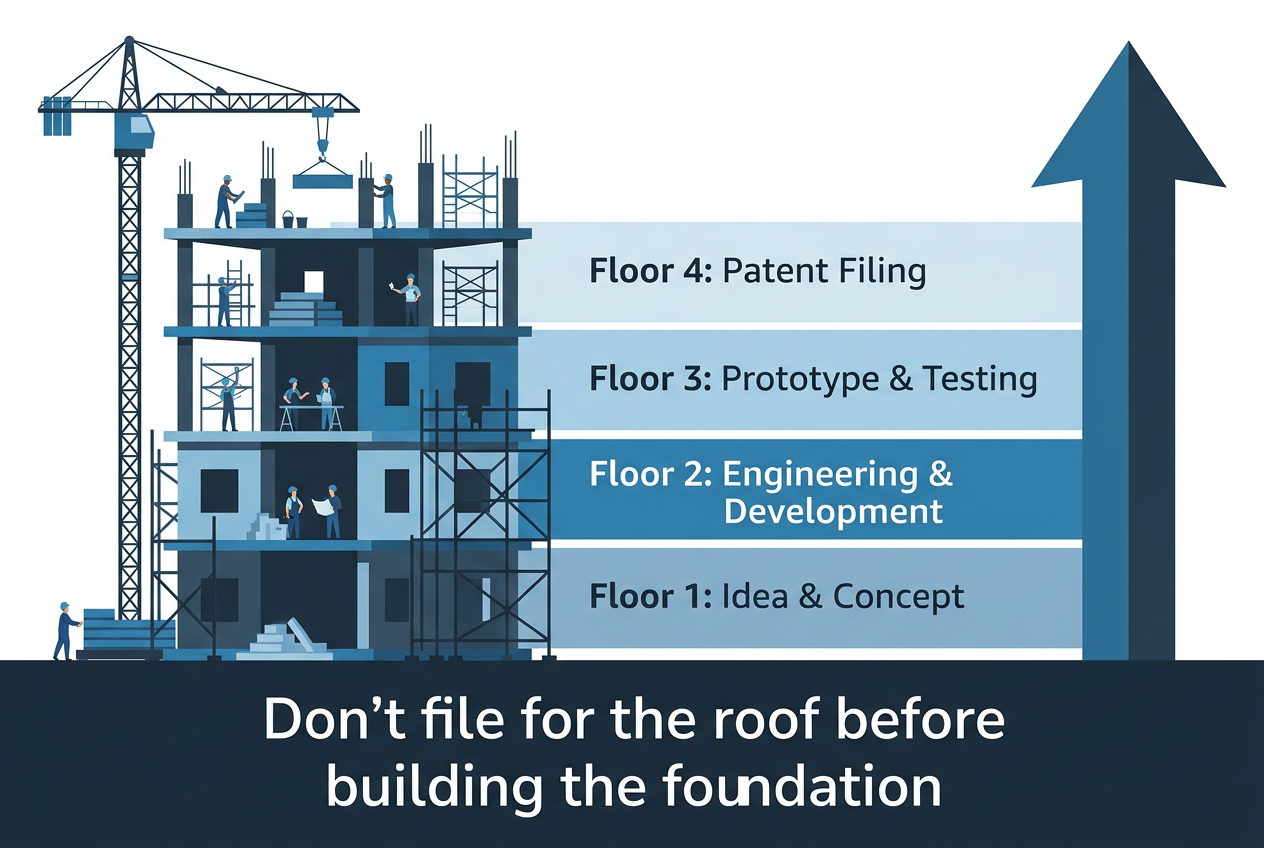
We tell entrepreneurs that product development is similar to building a multi-story building. First you pour the foundations, which are essentially the idea. Then you progress to development to understand where problems might arise, and after completing the development and building a prototype or POC, depending on the product's complexity and how many failure points need to be overcome along the way, you can then address all intellectual property matters.
Just as you would not build a third floor before pouring foundations and building the first and second floors, here too it is better to complete the early stages in an orderly manner so that the patent application will be as precise as possible and will not require additional changes and updates in the future that will also cost money and may complicate the original application that was filed.
Our years of experience have taught us that in many cases, registering a patent in advance on an idea that harbors engineering solutions that have not yet been tested and proven has caused the inventor no small number of problems. This is because every alternative solution that did not match the patent application filing was rejected since the inventor did not protect it. This narrowed the alternatives and engineering solutions available to us to offer the entrepreneur to complete their product - something that could sometimes even threaten the entire venture.
The Dating Analogy
Just as you would not meet someone at a bar and immediately propose marriage, but rather first ask them out, probably move in together, and only after a period formalize the relationship with a wedding, the matter is very similar here as well. First you meet the idea, verify it does not already exist, check that it is feasible and executable, and after you have examined everything, you can file a patent application, which is essentially a wedding between the entrepreneur and the idea through securing the entrepreneur's rights to the idea via the patent application.

Tip From the Experts
Just as you would not propose marriage on a first date at a bar, do not rush to formalize your relationship with your idea before getting to know it deeply. First examine compatibility, make sure the idea is physically and financially feasible, solve problems that arise in the field, and only after all the foundations are solidly poured, sign the documents and file the application. This way you ensure that the protection you receive truly covers the product you will manufacture for the market.
Key Takeaways
Wait for Development
Complete core engineering and prototyping before filing to ensure your patent covers the actual product you will manufacture.
Early Filing Risks
Filing too soon can lock you into an unproven solution, leaving improved designs unprotected and vulnerable to competitors.
Build Floor by Floor
Product development is like building construction - pour the foundations first, then build up systematically before adding the legal roof.
Comprehensive Coverage
A well-timed patent application filed after prototyping covers all refined engineering solutions and mechanisms.
Use NDAs Early On
Before patent filing, protect your idea through strict confidentiality agreements with every party involved in the development.
Not Always Necessary
Some consumer products benefit more from speed-to-market advantage than from expensive long-term legal protection.
Frequently Asked Questions
Should I file a provisional patent before starting development stages?
The prevailing recommendation is to avoid doing so if possible. A provisional application does give you a priority date, but it requires you to file the full documents within one year. Often, one year is not enough time to complete all engineering and testing processes, and you will find yourself filing documents that do not reflect your actual product.
What if someone discovers my invention during development and copies it?
To protect yourself in the early stages, before involving legal authorities, it is essential to use strict confidentiality agreements with every party you come in contact with. Working with professional and reputable engineering firms ensures you complete discretion throughout the entire process, so the risk of information leaking drops significantly.
How long does the process take from the sketching stage until ready for legal filing?
The time varies greatly and depends on the project's technological complexity. Relatively simple plastic products can reach this stage within a few months, while complex electromechanical systems requiring strict standards can take a year or even longer of intensive work before their mechanisms can be finalized.
Does every new product need legal protection to succeed commercially?
Not at all. In many cases, especially with simple consumer products or gadgets whose trends pass quickly, the advantage of being first to market and rapid market penetration are far more important than expensive long-term legal protection. Each case should be examined on its own merits together with professionals to understand what the most appropriate business strategy is.
What is the difference between protecting external design and protecting a technological solution?
Technological protection refers to how the product works, its internal mechanisms, and the method it implements to solve a problem. Design protection, on the other hand, refers only to the external appearance of the product and its geometric shape. It is important to know that separate applications for both areas can be filed simultaneously.
How does building a working model affect the quality of documents filed with the authorities?
Building a physical model reveals design problems that cannot be seen on a computer screen, such as material friction, heat dissipation, or real-world manufacturing limitations. Solving these problems generates new and smarter mechanisms, which are exactly what should be included in the legal documents to provide your invention with comprehensive protection resistant to imitations.